

Música d'Outrora
Continuo Foundation grantee
Supported by Continuo Foundation
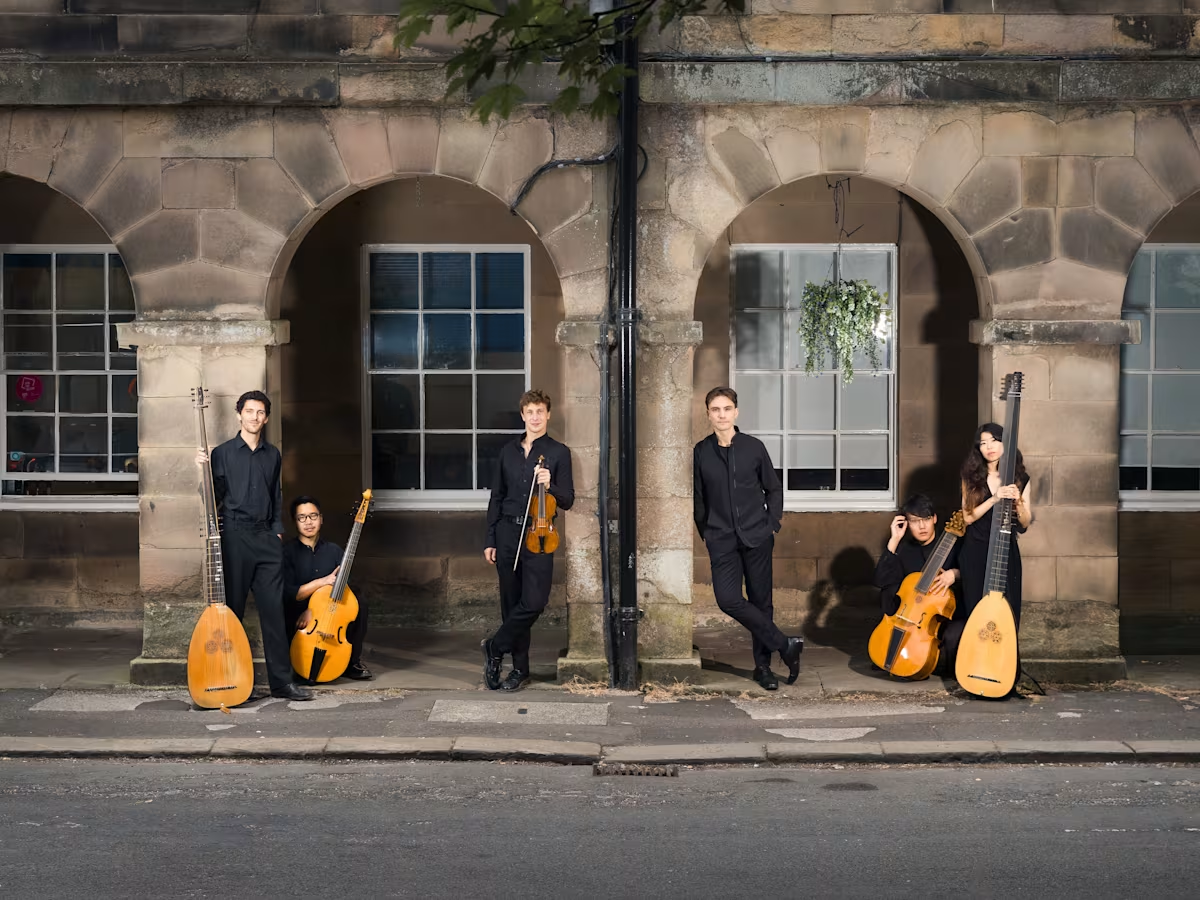
Música d'Outrora takes as its subject the seventeenth century – a moment when music was understood as a force of nature, capable of wounding, moving and transforming, of working at once on the body, the emotions and the spirit. The ensemble's purpose is to recover that power: to place the closest study of sources, instruments and performance practice wholly at the service of expression.
Central to its art is the aesthetic of contrast. Rather than seeking gradual development, seventeenth-century composers worked through sudden juxtaposition – the musical equivalent of the painter's chiaroscuro – building each work from a succession of complete affective worlds, devotional, dramatic or dance-like, in the free and fantastical manner the age called the stylus phantasticus. Música d'Outrora performs this repertoire as a series of ecstatic moments, in which time seems to pause and a single feeling is explored to its depths.
That intensity is carried by an unusually full continuo — organ, harpsichord, theorbo, baroque guitar, lirone and violone — a palette of colour and shadow that lets every harmony be shaded and every gesture inflected.
Since its founding, the ensemble has performed at BREMF Live! (Brighton Early Music Festival) and toured the United Kingdom with 'Across the Alps', supported by the Continuo Foundation. Its debut album, Still Life: Early Baroque Fantasy (Deux-Elles, 2025), explores the stylus phantasticus and includes the first recordings of Gregorio Strozzi and Ignazio Albertini alongside sonatas by Castello, Buxtehude and Stradella. Made with the support of the Continuo Foundation and Angel Early Music, it was awarded a Melómano de Oro and praised by Ritmo for a reading 'tremendously alive… full of nuances, colours and contrasts.'
In 2026 the ensemble appeared live on BBC Radio 3's In Tune and returned to the UK stage at the National Centre for Early Music (York), the Oxford Festival of the Arts, St Cecilia's Hall (Edinburgh) — the oldest concert hall in Scotland, where the Edinburgh Music Review found the ensemble 'delighted us with some superb playing' — and the Buxton International Festival.
Directed by Pablo Devigo – a Spanish conductor and harpsichordist, Fulbright Scholar and doctoral researcher whose work extends from Spanish Baroque theatre to the early Italian sonata – the ensemble continues to establish itself as a distinctive voice in the Early Music of the UK and Europe.

Biography

Música d'Outrora is a period-instrument ensemble founded in 2022 by the Galician conductor and harpsichordist Pablo Devigo (b. 1989). Active internationally, it is devoted to the seventeenth century and its stylus phantasticus — a music of freedom, fantasy and sudden contrast — performed with an unusually full continuo and an unapologetically expressive intent.
Música d'Outrora takes as its subject the seventeenth century – a moment when music was understood as a force of nature, capable of wounding, moving and transforming, of working at once on the body, the emotions and the spirit. The ensemble's purpose is to recover that power: to place the closest study of sources, instruments and performance practice wholly at the service of expression.
Central to its art is the aesthetic of contrast. Rather than seeking gradual development, seventeenth-century composers worked through sudden juxtaposition – the musical equivalent of the painter's chiaroscuro – building each work from a succession of complete affective worlds, devotional, dramatic or dance-like, in the free and fantastical manner the age called the stylus phantasticus. Música d'Outrora performs this repertoire as a series of ecstatic moments, in which time seems to pause and a single feeling is explored to its depths.
That intensity is carried by an unusually full continuo — organ, harpsichord, theorbo, baroque guitar, lirone and violone — a palette of colour and shadow that lets every harmony be shaded and every gesture inflected.
Since its founding, the ensemble has performed at BREMF Live! (Brighton Early Music Festival) and toured the United Kingdom with 'Across the Alps', supported by the Continuo Foundation. Its debut album, Still Life: Early Baroque Fantasy (Deux-Elles, 2025), explores the stylus phantasticus and includes the first recordings of Gregorio Strozzi and Ignazio Albertini alongside sonatas by Castello, Buxtehude and Stradella. Made with the support of the Continuo Foundation and Angel Early Music, it was awarded a Melómano de Oro and praised by Ritmo for a reading 'tremendously alive… full of nuances, colours and contrasts.'
In 2026 the ensemble appeared live on BBC Radio 3's In Tune and returned to the UK stage at the National Centre for Early Music (York), the Oxford Festival of the Arts, St Cecilia's Hall (Edinburgh) — the oldest concert hall in Scotland, where the Edinburgh Music Review found the ensemble 'delighted us with some superb playing' — and the Buxton International Festival.
Directed by Pablo Devigo – a Spanish conductor and harpsichordist, Fulbright Scholar and doctoral researcher whose work extends from Spanish Baroque theatre to the early Italian sonata – the ensemble continues to establish itself as a distinctive voice in the Early Music of the UK and Europe.
Musicians
- Asako UedaLute, Violin, Theorbo
- Pablo DevigoHarpsichord, Organ
- Tim LinViola da Gamba, Cello
- Conor GricmanisViolin
Share this

Upcoming Concerts
Listen
Past programmes

Still Life: Early Baroque Fantasy
 Wed, 22 Jul 2026
 St John's Church, Buxton
 11:15am
 £22 - £27
 Buxton International Festival
- ➕1 other performance
Emerging Ensemble Showcase
- Sat, 20 Jun 2026
- Grove Auditorium, Magdalen College Oxford
- 2:00pm
- £5 - £15
- Oxford Early Music Weekend

Still Life
- Sun, 15 Feb 2026
- National Centre for Early Music, York
- 7:30pm
- £20 (£16 concessions)
- ➕2 other performances

Across the Alps
- Tue, 22 Aug 2023
- Old Saint Martin's in the Cornmarket, Worcester
- 7:00pm
- £20 (£10 student/concession)
- ➕2 other performances