

Feature
Attila the Stockbroker: Early Music’s punk radical
Share this

BY SIMON MUNDY | FIRST PUBLISHED 2 AUG 2026
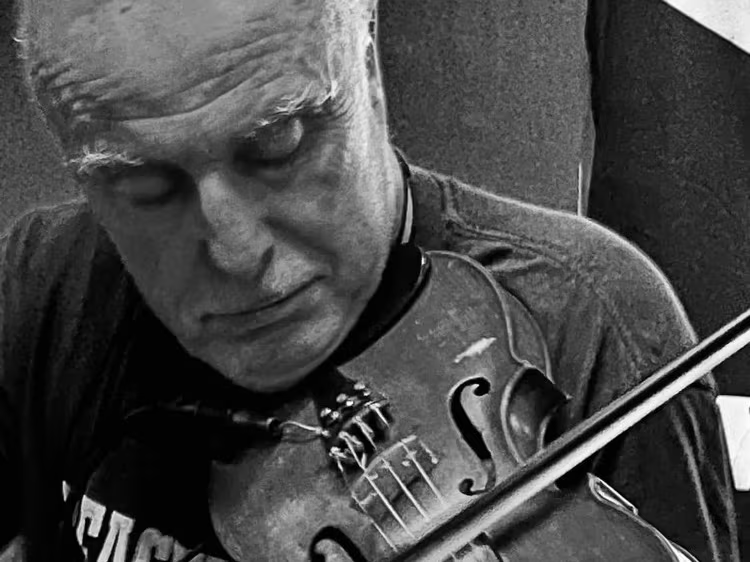
Attila the Stockbroker, real name John Baine, is an unreconstructed rebel. He fulminates against those who presume to have the right to tell him what to do. He excoriates the powerful in verse and blows raspberries at them on crumhorns. For nearly 50 years, he has been a fixture of the punk movement, tearing down the assumptions of good taste and the pavilions of the establishment.
His band, Barnstormer 1649, is a random-seeming assembly of punk bass, neo-prog guitar and Cromwellian military drum, topped with a succession of fiddle, mandola, tenor and alto recorders, Krummhorn (crumhorn), rauschpfeife and sausage bassoon (rackett). It creates an evocative soundscape against which to set a rigorously researched lyrical rip through the 1649 English Civil War chaos and, particularly, the oft-overlooked failure of the English Commonwealth.
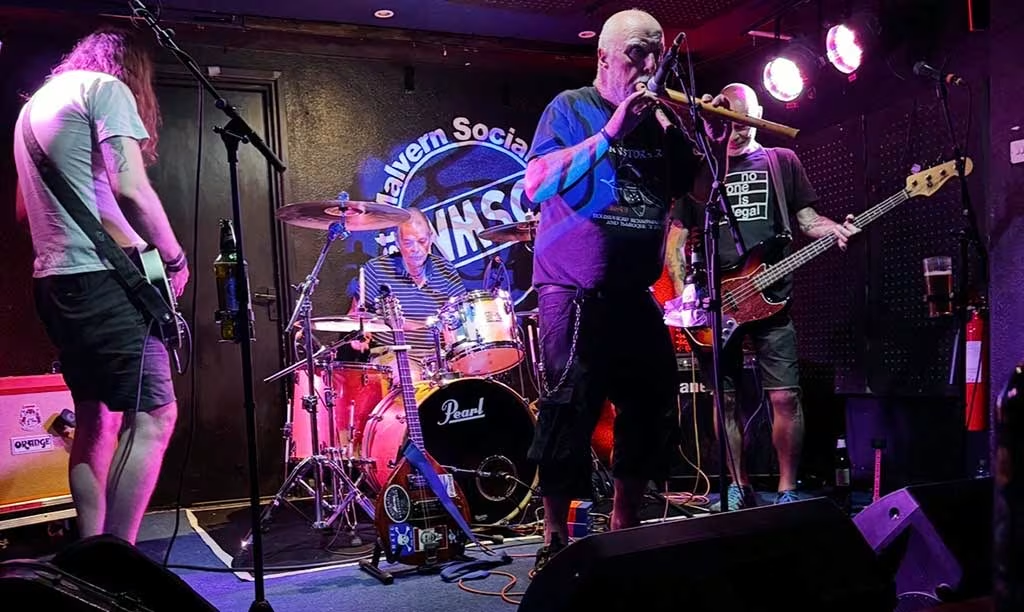
And yet... this August will find him at the Edinburgh Festival Fringe. Nothing unusual about that – he’s performed there regularly since 1982. But in addition to his poetry and music show with his mate, John Otway, at the legendary Bannerman’s Bar in Cowgate, you’ll find him opposite, in the Georgian surroundings of Scotland’s oldest concert room.
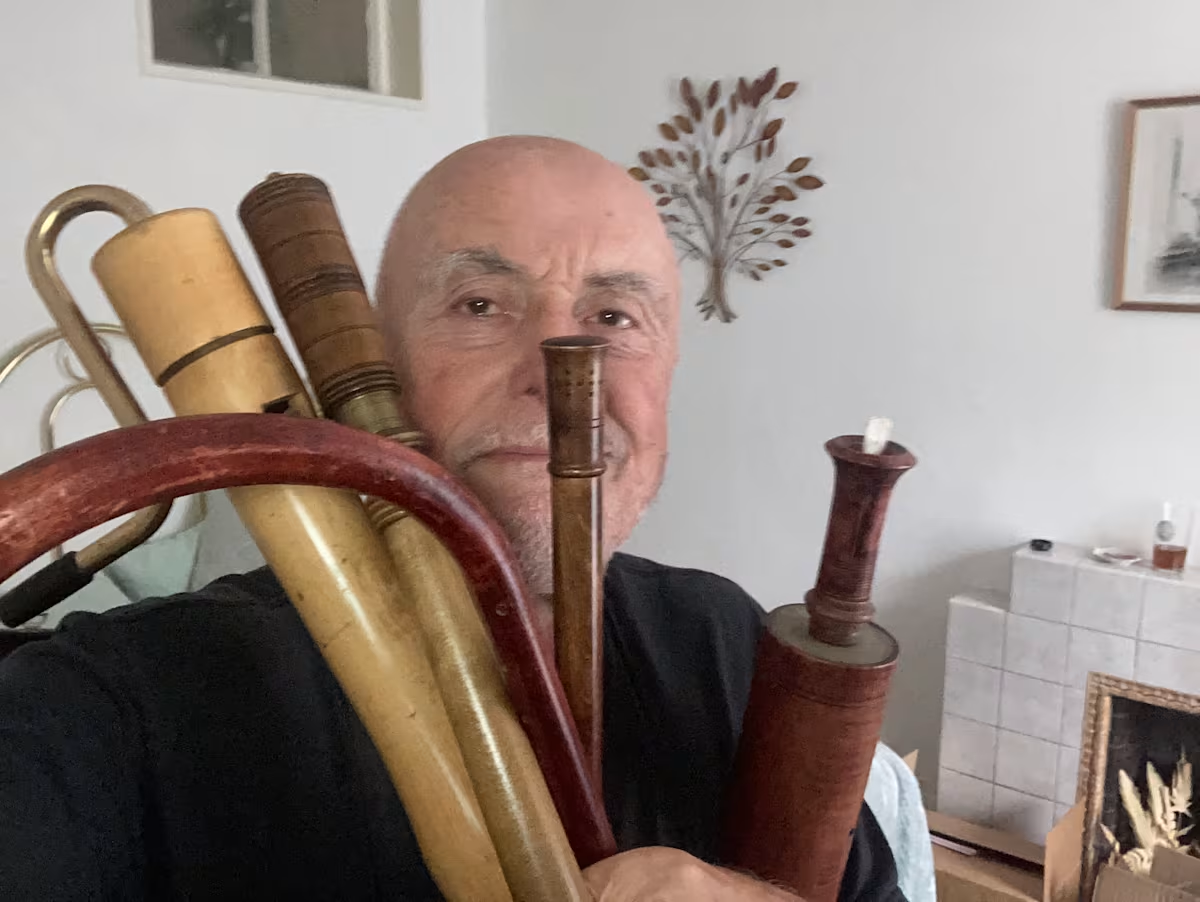
St Cecilia’s Hall dates from 1763; it's on the corner of Cowgate and Niddry Street and is the home of the University of Edinburgh’s world-renowned collection of early keyboards and other instruments. As a self-taught Early Music punk, Attila says he feels honoured to have been invited back there – along with his own formidable collection of ancient instruments – to perform his Early Music Show for the fifth consecutive year.
Its location has something of Attila’s contradictions. The hall sits in what was once one of the most notorious and ill-lit areas of the old town. That all changed from the 1980s onwards, but some of the buildings in the vicinity may still feel forbidding to some, in stark contrast to the cheery Royal Mile up the hill. Thankfully, the Hall’s Niddry Street entrance immediately warms the atmosphere with a bronze screen modelled on the soundboard of a 1725 harpsichord, and patterned with exotic birds and flowers, a common theme for keyboard decorations of that era.
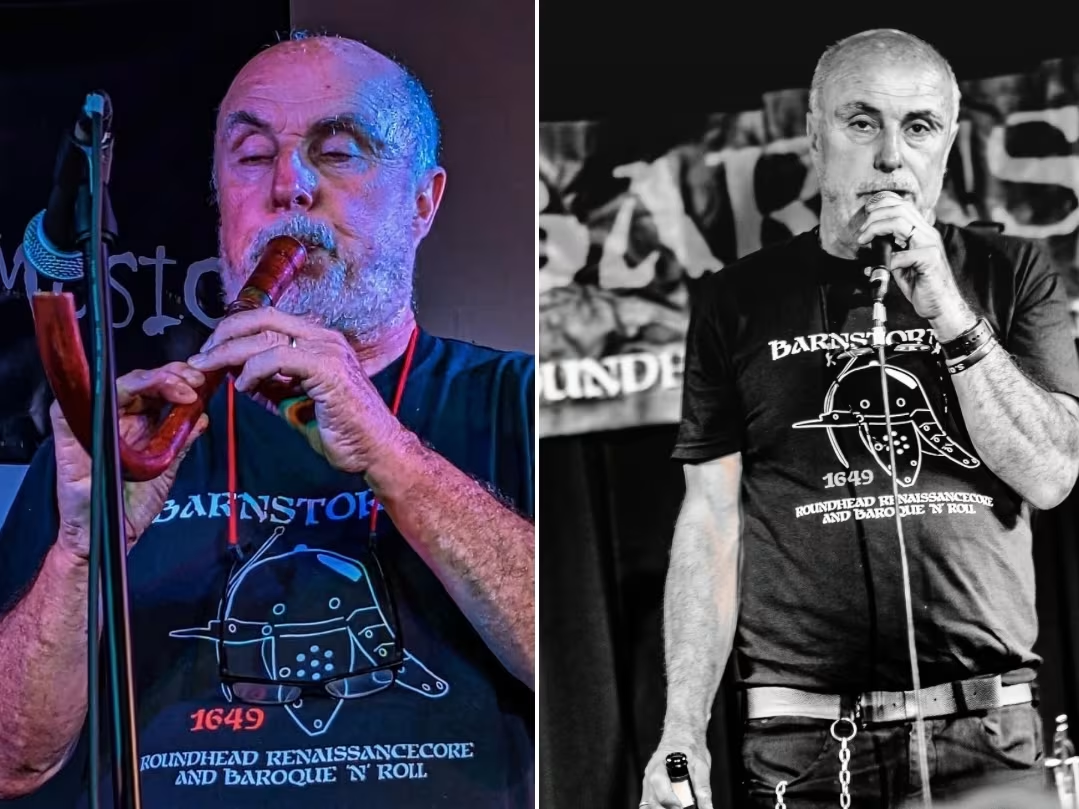
Attila shouts and provokes. He belongs to a tradition that the Early Music world of cloisters and colleges tends to flinch at: that of the boys who rampaged in footballing mobs through ancient cities, freeing the King’s prisoners as they went – the noisiest groundlings in Shakespeare’s theatres, but for whom the best jokes were written. He is a radical, digging up the neat plantings of pomposity. But Early Music was never only the province of the manuscript. It was just as often the expression of real life in the pubs and fairs. To glimpse this, read Ben Jonson’s St Bartholomew’s Fair or hear Purcell’s less-than-politically-correct glees: these two men grew up at the heart of Westminster when its slums were every bit as frightening as Cowgate.
Attila The Stockbroker | ‘The Levellers’ Trilogy’, the opening track from his 2018 signature album, Restoration Tragedy
Unlike them, Attila is no Royalist. ‘Charles II escaped to France in 1651 from a spot about 400 yards from where I live. While I was writing my Restoration Tragedy album, I dreamt I was a Cromwellian guard at Shoreham port and was too p***ed to stop him getting away. I turned it into one of the songs!’ I suspect, though, that Attila would have bristled just as much at the restrictions of the Puritans on roaring radicals like Ranters’ leader Abiezer Coppe once the republic was declared. He is not a man who puts up with fetters.

For all that, he comes from a very normal 1960s Sussex background. ‘I've had a feeling for Early Music ever since I was six and was given my first recorder at school. Lots of the others made a noise – I wanted to play it! Performing Early Music comes naturally. My mother was in the Royal Choral Society and the Brighton Festival Chorus, but I felt restricted sitting there, listening. What I do is just inside me; it’s just there. I want to respond to my love of the sounds and forms and popularise the old instruments for people who would never go to an Early Music concert normally – just as David Munrow once did.
‘People say, “You can’t write Early Music,” but I don’t see why not! A lot of it has a basic simple chord structure. I’d say what I do is one half David Munrow (I heard The Pied Piper when I was 13) and one half The Clash. I’ve been a lifelong lover of Early Music. All I do is by ear; I can barely read music, but my wife is the opposite. She reads music and is a respectable Labour Councillor. I make up my own, and I have a column in the Morning Star. My beef with classical music and mainstream poetry is the same. It’s too restrictive.
'Much of what I write now is Early Music crossed with punk – no one else is doing that. I want to do for Early Music what The Pogues did for Irish music: combine it with punk energy and take it to a new audience. I’m the founder of the Recorder Liberation Front. Every child should be given a recorder but be made to promise to play it properly. When I was young, I joined a local consort. Then I got bored, because I wanted to make the music up myself. What I do is a bit rough and ready, and I’m not a virtuoso on anything, but then neither were my 17th-century street music equivalents! I do have perfect pitch and I’m passionate about the form.’
 ▶
▶‘Attila The Stockbroker: 35 years a punk poet’ – a mini-documentary directed by Farouq Suleiman
The two loves of his performing life came together when he was offering his punk side in Bannerman’s on Cowgate, the bar opened in the early 1980s by Julian Bannerman as a poetry (and now rock) dive in medieval cellars. ‘I was in Bannerman’s in 2021 and looked across the road and saw that St Cecilia’s Hall had this fantastic early instrument collection. I just walked over and thought I could link the two sides of the street. These days I do 90 to 100 gigs each year around the country, and nearly all contain an element of Early Music, but my Early Music Show is devoted to it.
At 68, I’m doing it late in life but with humour, energy and, I hope, a sense of tradition to pass on to the next generation.’
As part of this year’s Edinburgh Festival Fringe, Attila The Stockbroker will be presenting his Early Music Show at St Cecilia’s Hall (14 & 21 August) as part of PBH’s Free Fringe (no booking required) with accompanist and singer/songwriter Calum Baird on guitar. Attila himself will be playing crumhorn, rauschpfeife, cornamuse, five different recorders, violin and mandola. Their programme will feature Attila’s songs from his 2018 album, ‘Restoration Tragedy’, about the tumultuous events in England after the execution of Charles I in 1649. Purchase the album on CD or double vinyl along with Attila's collected works and autobiography from his Bandcamp page, and for booking enquiries contact him on Facebook or Instagram or via attila@attilathestockbroker.com.
Share this
Keep reading
Spiritato: music out of boundless curiosity
Continuo Connect catches up with Will Russell and Kinga Ujszászi, founding members of the ensemble Spiritato.

Sam Brown on Dowland and filtering history through a modern lens
Lutenist Sam Brown of Dowland's Foundry chats with Simon Mundy about how we interpret John Dowland, the formation of the ensemble around Emma Kirkby's kitchen table, and an exciting recording project in the pipeline.

In conversation: Bolette Roed
Continuo Connect talks to the Danish recorder player Bolette Roed about her group, the Elephant House Quartet, and Copenhagen Baroque Festival.