

Film
Cooking a Musical Pie
Introducing the Pasticcio
Share this

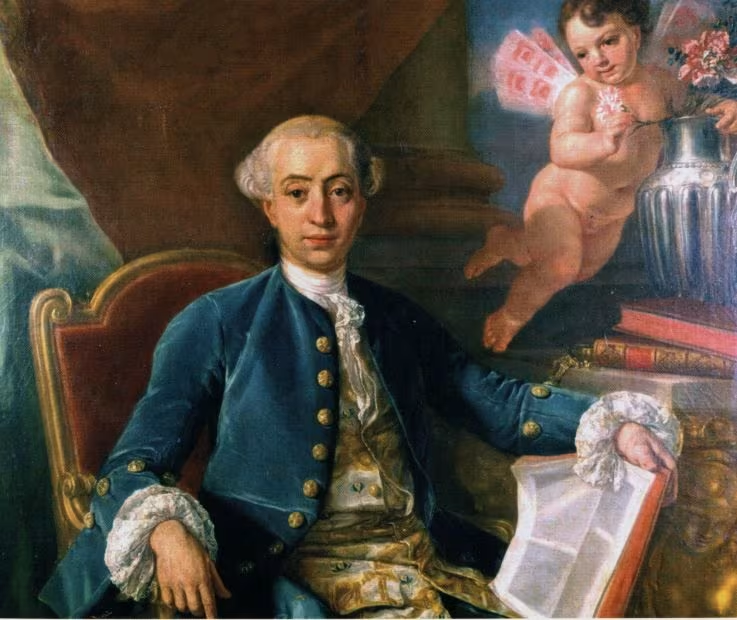
‘He takes other men’s pebbles and polishes them into diamonds.’
So said William Boyce concerning Handel’s now notorious habit of incorporating music by other composers into his own works. But was such musical alchemy an unusual practice in the Baroque period?
 ▶
▶Watch Julian Perkins in conversation with librettist Stephen Pettitt alongside some musical excerpts from Casanova, performed by Sounds Baroque and soloists.
Not at all! Unlike today, when copyright laws aim to prohibit such ‘plagiarism’, many Baroque composers were pre-advocates for the Green Party, often recycling their material in their own works – and apparently even felt flattered when their colleagues used their musical ‘pebbles’ (without acknowledgment) in their own pieces. With some notable exceptions (including Bach and Handel), many 18th-century composers seemed relatively indifferent about securing a legacy. Penning a work back then was like crafting a piece of handmade furniture, far removed from the Romantic notion of creating an original masterpiece. Like magazine articles, compositions were functional: often in circulation for a few weeks or months, before being relegated to the archives in favour of something more current.
Such a culture poses fascinating questions. What do we mean by an ‘Urtext’ edition? In how many versions can a single work exist, and how comfortable are we in accepting that some works are by more than one composer?
Enter the pasticcio, an Italian word for a ‘pie’ – or even a ‘mess’. Pasticci were popular theatrical entertainments throughout the Baroque era and beyond. They were concocted from various works, frequently by different composers, and sometimes in a mix of languages. Recitatives were usually composed by the compiler (akin to the story-lines of Mamma Mia! or Jersey Boys) to act as compositional glue in linking arias in often disparate keys, and there was little concern about the musical authorship of such creations. At a time when singers (especially castrati) were the undisputed stars, these musical buffets enabled impresarios to attract the best performers with a catwalk of impressive arias. Plots were largely secondary matters, and the bigger the stars’ egos the fewer the number of ensemble pieces. Singers themselves often insisted on performing their own showpieces – or ‘baggage arias’ – in these concoctions; the castrato Luigi Marchesi even refusing to appear in any opera unless he made his first entry on horseback while singing his favourite aria! But let’s not assume that such decadence is confined to the Baroque; not until Mahler’s legendary tenure at the Vienna State Opera at the turn of the 20th century was the ‘baggage aria’ famously returned to sender.
Baroque Unwrapped 2016 at London’s Kings Place provided a rare opportunity for myself and Sounds Baroque to explore this pliable approach to music in the 18th century by devising a pasticcio about Casanova. A violinist, dancer and probable inspiration behind Don Giovanni (besides much else), the irrepressible Casanova was surely the most colourful chronicler of the 18th century. Including works by Gluck, Hasse and Mozart, Casanova recounts the sensational events surrounding his ultimate conquest: his return to Venice in 1774 after 18 years of exile.
by Julian Perkins
Casanova had its world première at Kings Place, London, on 6 May 2016. Praised by the Opera magazine as a 'witty pasticcio', it has also featured on BBC Radio 3 ('Expect to be shocked, or possibly seduced...') and been performed as the opening event of the Two Moors Festival, the JAM on the Marsh Festival in Kent, and for Coram's annual Handel Birthday Concert.
Libretto by Stephen Pettitt. Musical arrangements, recitatives and a teasing musical fake by Julian Perkins. Original cast: Augusta Hebbert (soprano), Anna Starushkevych (mezzo-soprano), William Towers (countertenor), Ashley Riches (baritone) and Neil Summerville (narrator)

Share this
Keep reading
LIFEM 2026: Interview with Eun Sol Lee
The Early Music Shop caught up with Sol to find out more about her year since she won the competition, and what we have to look forward to in her performance at LIFEM this year...
Touching Bach: an immersive experience of the St John Passion
If we find a piece of music “touching”, it means it makes us feel something. But, like most metaphors, this one has a literal dimension, which becomes very evident when you dig into its history.
Playlist: Continuo Patrons
A playlist of tracks by Continuo Foundation Patrons Mary Bevan, Emma Kirkby, Rachel Podger and Ashley Solomon in celebration of the UN International Day of Charity.