
Film
Academy of Ancient Music | Rejoice! Music of Bach, Handel & Purcell
Share this

FIRST PUBLISHED 25 JUL 2026
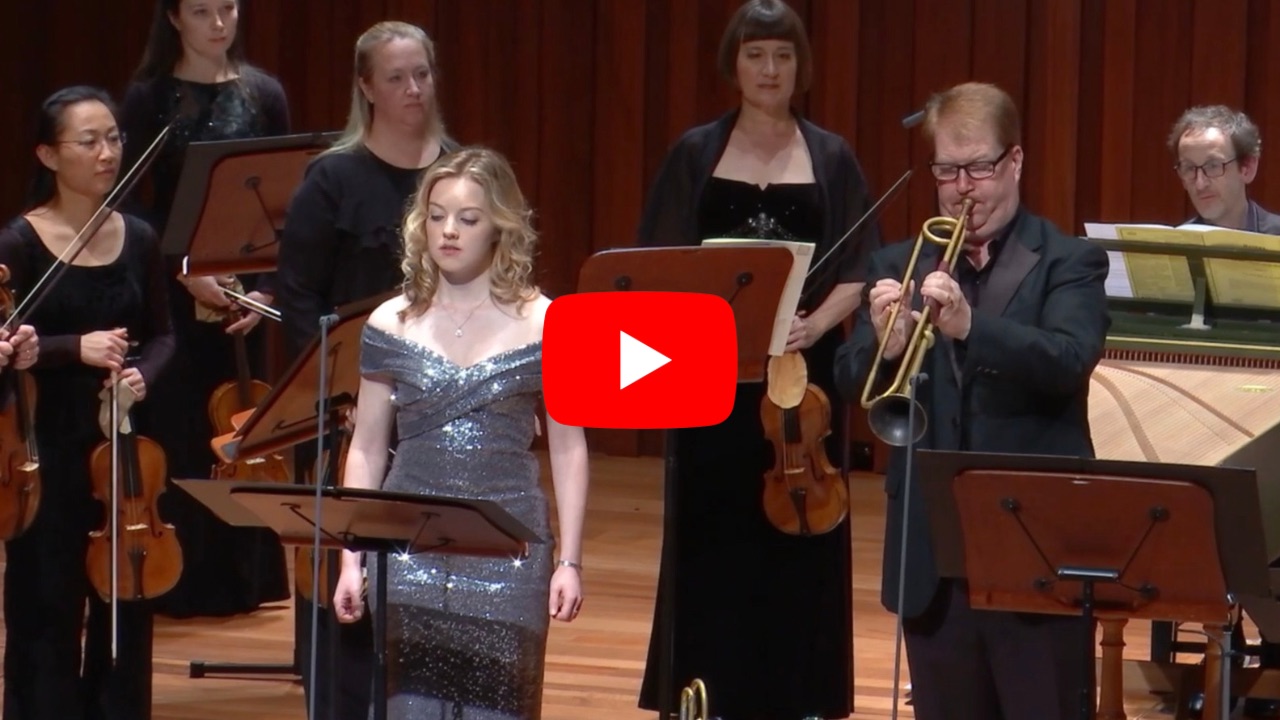
Royal Wedding (and AAM principal) trumpeter David Blackadder joins soprano Rowan Pierce and the Academy of Ancient Music for ‘Rejoice!’, a spirited programme of Bach, Handel, Purcell and Corelli.
Filmed at Milton Court Concert Hall on 24 October 2019.
PERFORMERS
Rowan Pierce soprano
David Blackadder trumpet
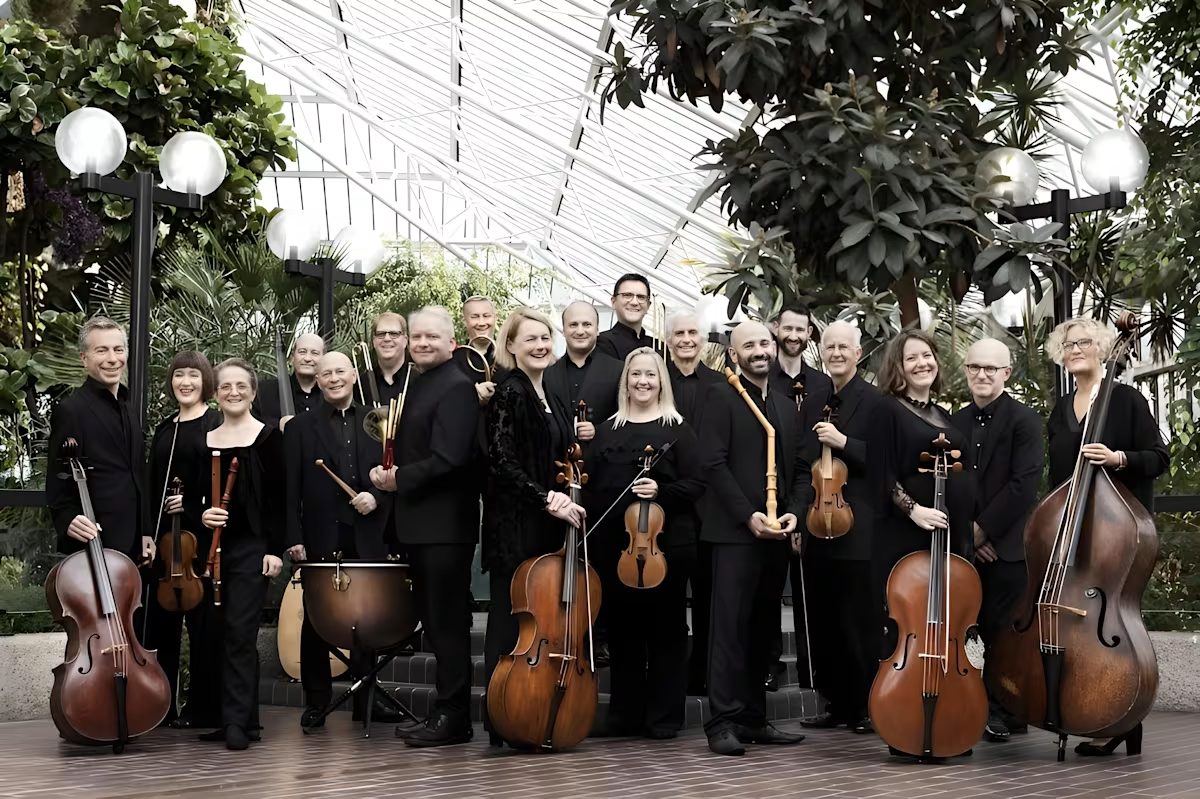
Academy of Ancient Music
VIOLIN I Bojan Čičić (leader), Liz MacCarthy, Sijie Chen
VIOLIN II James Toll, Persephone Gibbs, William Thorp
VIOLA Jane Rogers, Jordan Bowron
CELLO Sarah McMahon, Imogen Seth-Smith
DOUBLE BASS Judith Evans
ORGAN & HARPSICHORD Stephen Farr
THEORBO William Carter
KEYBOARD TECHNICIAN Malcolm Greenhalgh
PROGRAMME
Clarke Mr Shore's Trumpett Tune
Handel ‘Rejoice greatly, o daughter of Zion’ from Messiah, HWV 56
Corelli Concerto grosso in D, Op. 6 No. 7
Tortelli Trumpet Concerto in D (unknown)
Handel ‘Gloria in excelsis Deo', HWV deest
D Purcell ‘Sound the Trumpet’ from The Masque of Hymen
Handel ‘Let the Bright Seraphim’ from Samson, HWV 57
Handel Concerto grosso in G, Op. 6 No. 1 (HWV319)
JS Bach Cantata ‘Jauchzet Gott in allen Landen’, BWV51
PROGRAMME NOTES | BY JO KIRKBRIDE © AAM
There are few more jubilant and uplifting sounds in music than the natural trumpet. With its bright, piercing tone and rich timbre, it has become an emblem of the baroque, signalling occasions of joy, triumph and celebration. Writing around 1700, the renowned critic and amateur musician, Roger North, described the trumpet as a ‘small, portable, comodious and martiall tube’, one that was ‘glorious and admired’. With new advances in instrument technology, this was the golden age of the trumpet and just about every composer across Europe – from Bach to Vivaldi, Handel and Purcell – intended to make the most of this glorious new sound.
It is a little ironic, then, that the person responsible for composing the best-known piece for baroque trumpet is far from a household name. A successor to Purcell at London’s Chapel Royal and later organist at St. Paul’s Cathedral, Jeremiah Clarke (1674–1707) is now rightfully credited as the composer of the popular wedding voluntary The Prince of Denmark’s March – better known simply as the Trumpet Voluntary – but for many years the work (along with several others) was wrongly attributed to Purcell. Among a handful of other pieces for trumpet in his output is the brisk voluntary Mr Shore’s Trumpett Tune, composed for the leading English trumpet virtuoso of the day, John Shore. We know that both Purcell and Handel wrote some of their most demanding trumpets parts with Shore in mind, and although Clarke’s voluntary is somewhat modest by comparison, its high tessitura and skillful ornamentation give us a glimpse into Shore’s technical proficiency.
If Clarke was England’s trumpet composer du jour, then Giuseppe Torelli (1658–1709) held the same status in Italy. His catalogue contains more than 35 works for between one and four trumpets, making him by far the most prolific Baroque composer of his kind. The proliferation of music for trumpet owes much to his position in Bologna, then Italy’s most important cultural centre, which had at its centre the vast church of San Petronio. Often used as the site of celebratory and royal occasions, there could be no more fitting setting for the splendour of Torelli’s trumpet music, as the regal poise and grandeur of his Trumpet Concerto in D demonstrates. These were the early days of the concerto and Torelli – and then Vivaldi (whom Torelli is thought to have taught) – was instrumental in its development. It has many of the hallmarks of the mature concerto style, from the repeated ritornellos to the fizzing energy of its melodic writing in the later movements.
The popularity of trumpet music in the early 18th century also had a knock-on effect on other genres, often leading composers to mimic its distinctive, triadic melodicism when writing for other instruments, and even for the voice. Henry Purcell did so famously in the duet ‘Sound the Trumpet’ from his ode, Come, Ye Sons of Art, leading his son, Daniel Purcell (1664–1717) to follow suit just a few years later. Daniel Purcell even gave his aria the same name, but ‘Sound the Trumpet’ from The Masque of Hymen (c.1696) takes the allusion a step further, uniting the soprano voice with the trumpet itself. He was not the first to do so – the advent of the ‘trumpet aria’ can be traced back to Monteverdi and the ‘war-like’ style of his madrigals – but it was to prove a popular and compelling pairing that countless other 18th-century composers would replicate.
Few did so more successfully than George Frideric Handel (1685–1759), for whom the trumpet aria became something of a party piece. These were times of significant stylistic change in vocal music, with the influence of Italian opera creating an appetite for showmanship and virtuosity. For Handel, it presented an opportunity to transform the landscape of musical drama, synthesising elements from the opera house with those from the concert platform to create dazzling new showpieces with a far broader appeal. Oratorios provided the answer. Unlike operas, oratorios were intended for the concert stage rather than the theatre and did not require expensive sets or costumes, meaning they were cheaper to put on and could be performed almost anywhere. They were also more suited to the English language, which allowed Handel to write in a more direct and simple manner that had a far greater public appeal.
But if oratorios gave Handel a platform for greater artistic freedom, he had already laid down their foundations much earlier in his career, even as far back as his early sacred works. What we now know to be Handel’s Gloria in excelsis Deo setting is thought to have been composed as far back as 1707 when he was just 22 years old. The score and parts were only rediscovered in the library of London’s Royal Academy of Music’s in 2001, and although neither is in Handel’s own hand, its distinctive melodicism and use of dissonance have led scholars to attribute the work to Handel’s early style. This is not a modest, reticent setting of a familiar sacred text but a flamboyant work for coloratura soprano in an operatic style, likely to have been influenced by Handel’s travels to Italy in 1707. There is more than a hint of ‘Rejoice greatly’ from Messiah in the buoyant ‘Laudamus te’, while the deeply expressive ‘Qui tollis peccata mundi’ could just as easily have been lifted from one of his later opera arias. Handel was evidently pleased with the finished score, since numerous parts were later reused in other works, including his Chandos and Coronation anthems.
Handel composed his first oratorio, Esther, in 1718 and by the late 1740s, his oratorios had become iconic pieces of the repertoire. Messiah premiered in 1742 to great adulation, with Semele and Samson opening the next year. Samson contains perhaps the most iconic trumpet aria of them all, ‘Let the bright seraphim’, in which the soprano soloist summons celestial hosts of cherubim and seraphim in honour of the dead hero, Samson. Handel composed Messiah and Samson in parallel and although the ebullient soprano aria, ‘Rejoice greatly, O daughter of Zion’ does not include the trumpet, its contours and cadences nevertheless bring it to mind, as does its triumphant, fanfare-like theme.
While Handel is still best-known for his vocal music, he also composed a huge volume of instrumental concertos, including more than 30 concerti grossi – works that feature more than one soloist. The concertino (soloists) may comprise any combination of instruments, but in the case of the 12 concertos that make up Handel’s Op. 6 collection, the solo roles are given to two violins and a cello. Bridging the gap between Handel’s vocal and instrumental music, these concerti grossi were intended to be played between performances of his dramatic stage works, and in many cases they even borrow material from his odes and oratorios too. The Concerto grosso in G, Op. 6 No. 1, HWV319, is a case in point, having been reworked from an early draft of the overture to his
opera, Imeneo (1739).
Although Handel’s Op. 3 and Op. 6 collections became landmarks of the genre, he learned his craft from Arcangelo Corelli (1653–1713). Corelli was one of the most established and sought-after violinists of his day, but as a composer he produced relatively little. His reputation today rests on just six published opus numbers and a handful of posthumous publications, comprising 48 trio sonatas, 12 violin and continuo sonatas and 12 concerti grossi – all of which, unsurprisingly, have the violin as their focal instrument. But although Corelli was widely respected by his successors Geminiani, Locatelli and, later, even JS Bach as the ‘go-to’ violin composer of his day, he explored only a fraction of the instrument’s capabilities. Few of his works take in the violin’s uppermost registers because, sobthe story goes, Corelli himself was not comfortable playing them. While the writing for both the soloists and full strings in the Concerto grosso in D, Op. 6 No. 7 is relatively simple, the overall effect is one of joyful exuberance – largely thanks to Corelli’s frequent oscillations in tempo and character and some vigorous antiphonal writing.
Today’s programme closes with one of the most iconic works that Johann Sebastian Bach (1685–1750) would compose for trumpet – his Brandenburg Concerto No. 2 aside. Jauchzet Gott in allen Landen, BWV51 is the only cantata in Bach’s extensive catalogue to be written for soprano and trumpet, and it is every bit as showy as its scoring would suggest. On the score, Bach inscribed the words ‘per ogni tempo’ (‘for any time’), and although we know that it was later used for the 15th Sunday after Trinity, the virtuosic nature of the two solo parts suggests that Bach had the unusual privilege of writing for two extremely gifted musicians. It is difficult to imagine such a dazzling showpiece featuring in the standard Sunday morning service at Leipzig’s Thomaskirche, a service that began at 7am and lasted until noon, of which the cantata was just one small part. It appears more likely that it was first performed at a private court and later recycled in Leipzig, where one can only imagine the congregation’s startled reaction to the glittering passagework and stratospheric vocal line of the closing ‘Alleluia’.
To hear the Academy of Ancient Music live, check out the AAM Continuo Connect profile to view their upcoming concerts.
Share this
Keep reading
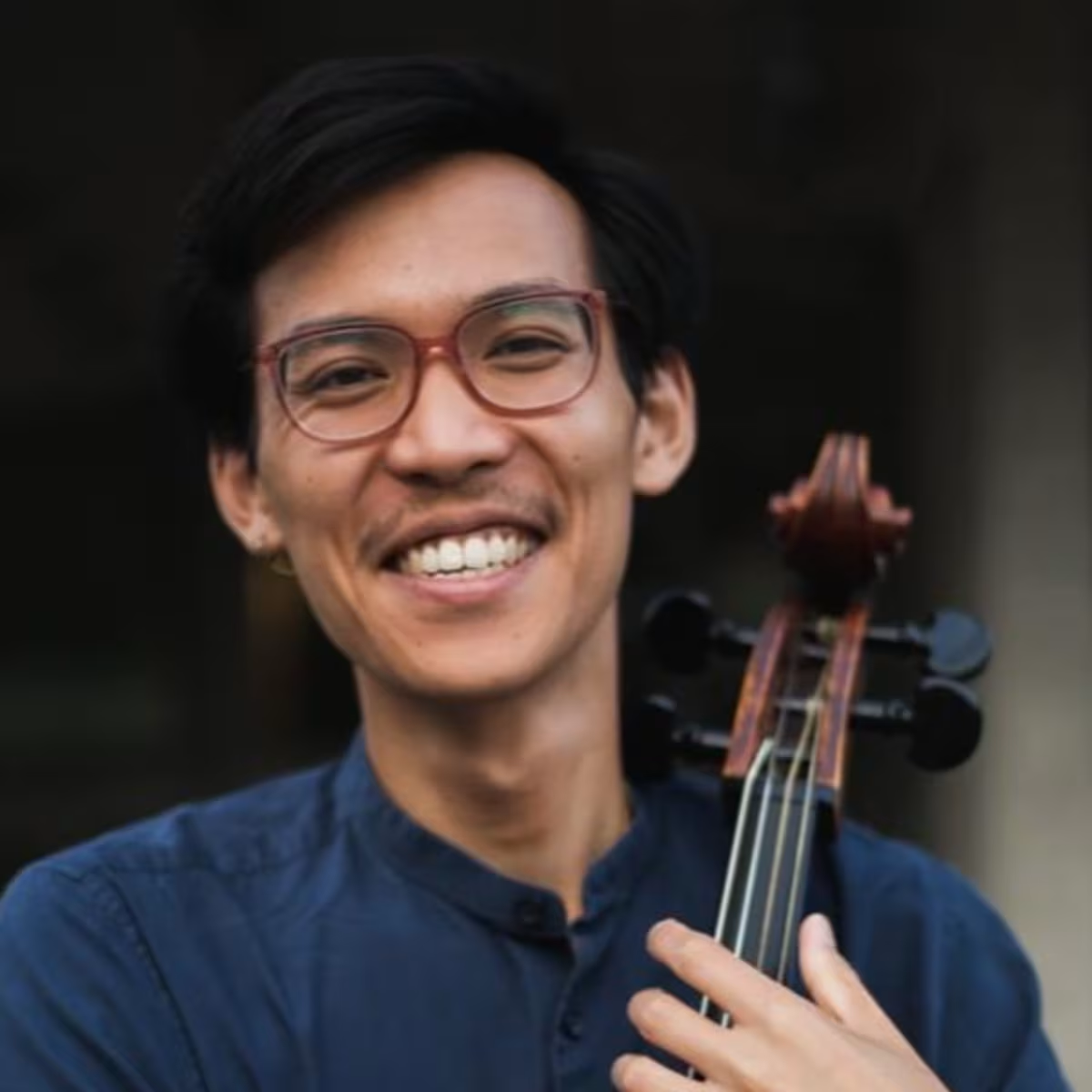
In conversation: Samuel Ng
Continuo Connect catches up with Samuel Ng, cellist and gamba player with the newly formed Republic of Viols and Liturina.
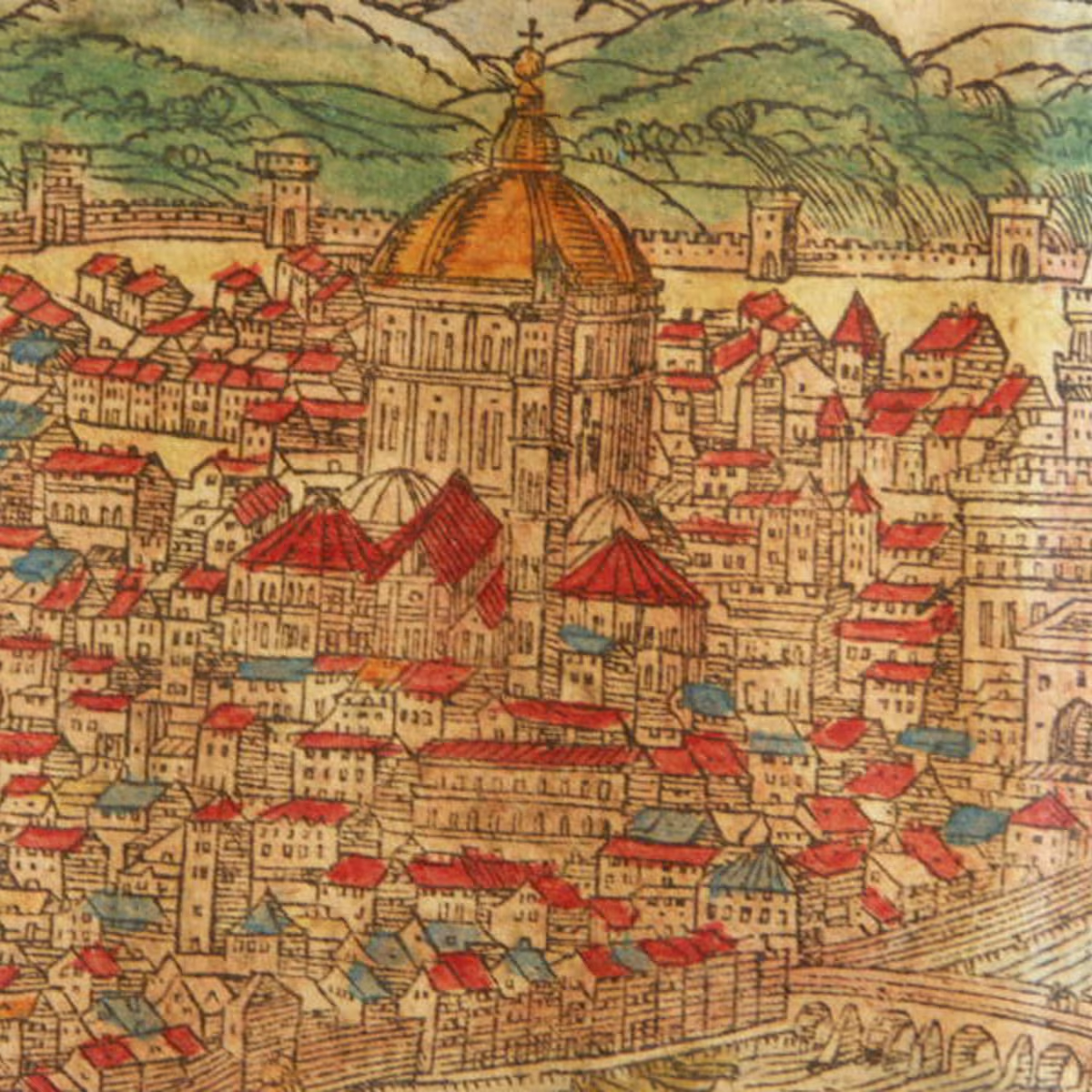
Exploring the golden age of the ‘City of Dreams’
‘City of Dreams’ is an exploration of two centuries of Renaissance Florence at Brighton Early Music Festival. We spoke to Oliver Webber, founder of Monteverdi String Band, and writer Saria Steyl about how the project came together.
The soundtrack of imagination: David Yardley and Green Dragon Guild of London
Medieval countertenor David Yardley, Artistic Director of Green Dragon Guild of London, discusses Medieval music, Southwark’s layered history, and how imagination and meticulous research meet in performance in our latest podcast.