

Podcast
The soundtrack of imagination: David Yardley and Green Dragon Guild of London
Share this


BY CONTINUO CONNECT | FIRST PUBLISHED 17 SEP 2026
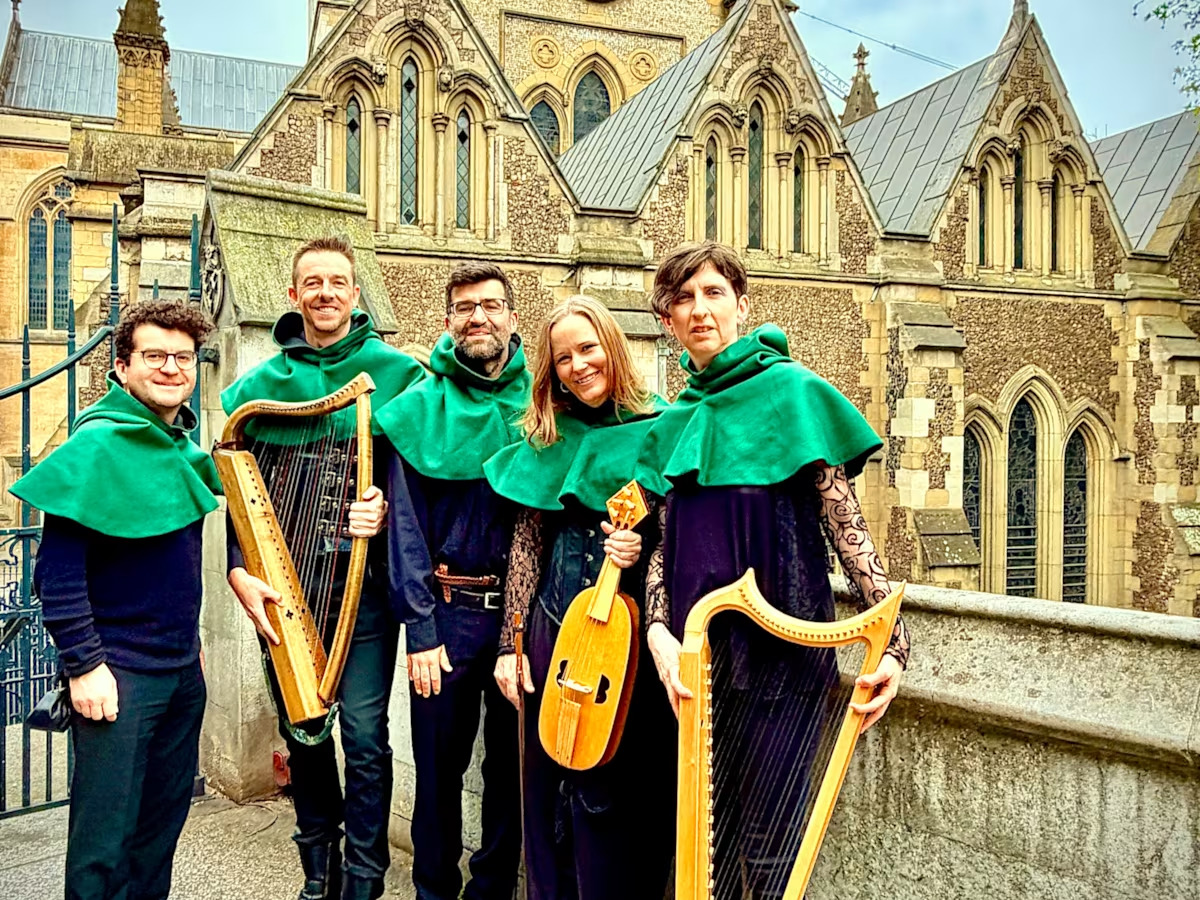
Medieval countertenor David Yardley, Artistic Director of Green Dragon Guild of London, discusses Medieval music, Southwark’s layered history, and how imagination and meticulous research meet in performance in our latest podcast with Simon Mundy. The Guild's next concert, Of Bestiaries and Bishops, is at St Sepulchre-without-Newgate on Wednesday 23 September. Yardley also co-directs the Medieval London Music Festival, which will have its inaugural edition in May 2027.
Prefer to read this interview? View an edited transcript of this podcast below.
Simon Mundy: What inspired you to start a group called the Green Dragon Guild?
David Yardley: I live here around London Bridge, in Southwark, close to Southwark Cathedral and Borough Market. Between the surviving Medieval corner of the cathedral and the market there's an old street, probably following the Medieval street plan, called Green Dragon Court. As soon as I saw that, I was intrigued about the Medieval history of the area – that's partly it, because it's the Medieval remnant, if you like. But the other thing about 'Green Dragon' is that it's had a whole other life in contemporary fantasy – the Green Dragon Inn in Tolkien and many other green dragons besides. A lot of the impetus for the group is bringing together that surviving Medieval remnant, rigorously researched, with the contemporary reception of the Middle Ages – the role fantasy has played in capturing modern imaginations around some of those old concepts.
The Green Dragon was presumably a pub around the corner from the cathedral, close to the remnants of the Rose Theatre and Southwark's other theatres, which were there because they weren't allowed in the City of London – and indeed the Tabard Inn, where Chaucer's pilgrims set off, just around the corner from Green Dragon Court. That area of Southwark was also part-ruled by the Bishop of Winchester, who was equally famous for the prisons and brothels running all the way through it. So it wasn't very clean, Medieval life.
It was all the layers of Medieval life in a single place. One of the things I think about with the group is that we often draw this big distinction between sacred Medieval music in sacred spaces and secular music over in the taverns and pubs, and I think a better approach is to look at how it's all integrated. The Bishop of Winchester is a perfect example – on one hand a bishop, on the other right in the thick of a bawdy area of Medieval London.
We think of sacred music as all being sung in Latin behind the rood screen, but actually one of the ways priests got locals into church was through entertainments and music that was fairly secular and closer to their everyday reality. You perform now for your concerts at St Sepulchre-without-Newgate, which I always think is a wonderful title, on Holborn Viaduct in the City of London. It's the largest of the Medieval churches in London, but it was totally revamped by Sir Christopher Wren after the Great Fire. I wonder about that rather complicated history – it now houses the Musicians' Chapel, commemorating musicians, but is also known as the place from which priests used to walk condemned prisoners to Newgate.
Exactly – and one of the things I was delighted to discover is that it was also one of the meeting places of one of the original Medieval guilds, the Guild and Fraternity of St Katherine. In some ways it's the perfect venue, because it has a through-line stretching back to 1137, when it was first recorded as receiving the property, through so many different iterations since – the Great Fire, its life as the national musicians' church, the Royal Fusiliers Chapel – that same sense of layered history building on a Medieval origin.
Tell me about the music you're performing there – or rather, before the specifics of the next concert, tell me about the sort of music you perform in general.
We perform primarily surviving music from the 11th to the 15th century, a mix of sacred and secular, augmented with a few pieces of contemporary composition. I write music I describe as 'Medieval-informed' and 'Medieval-inspired' – that might take an original Medieval text that has lost its music, since most of what survives to us is text without music, especially in a tradition like the Medieval English carols. For one of our coming concerts we're working with a contemporary poet who writes in that historical-fiction space, bringing that Medieval sound world to life around contemporary words.
The core of it is richly researched 11th- to 15th-century music, and we're extremely fortunate in the group to have Dr Leah Stuttard and Juliette Primrose, who go to the British Library to seek out 12th-century manuscripts or study facsimiles online – working from first principles about what has survived and how to interpret it, using modern scholarship, to create a workable performance. It's the same blend as the name – the surviving Medieval remnant, meticulously approached, alongside the modern question of how this music speaks to us now.
Now that you're up and running, I might point them towards the Muniment Room at Westminster Abbey and the chained library at Hereford Cathedral. Let's face it, Australia has about the least Medieval background possible – tell me how you came to find Medieval music in Sydney and what brought you to it.
I still look back on it to this day. I was 12, in Sydney, and my singing teacher at the time invited me along – he said, 'I know you love these sorts of stories of the period, King Arthur and so on – why don't you come and hear my group perform this weekend?' I remember going, and it was Medieval music performed there, and I sat there in goosebumps for the entire performance. My imagination was already very rich with that world, but it was like I'd found the soundtrack for it. I've been passionate about it for thirty years.
It's an interesting reflection, because in our group it's myself, from Australia; Juliette, who's from New Zealand; and then Leah, Richard de Winter and David de Winter, who are UK-based – and I think that makes for an interesting dialogue about Medieval music. Growing up in Australia, without that built environment around you, without that continuity between Medieval castles and the present day, the period takes on a mythical quality – it's the stuff of imagination from the start, because you're not surrounded by it. In the UK, growing up, it's part of a much more continuous story of the world around you. When those two things come together, you get an interesting tension between the historical dimension and the imaginary side of it – and I think that tension and imaginative rendering is exactly how so much of the Medieval period reaches the public and popular consciousness.
You're playing handheld harps as well as singing – I wondered where yours came from. I always associate the handheld harp with the clàrsach, or the Medieval Welsh harp of the bards who wandered the Welsh princes' courts.
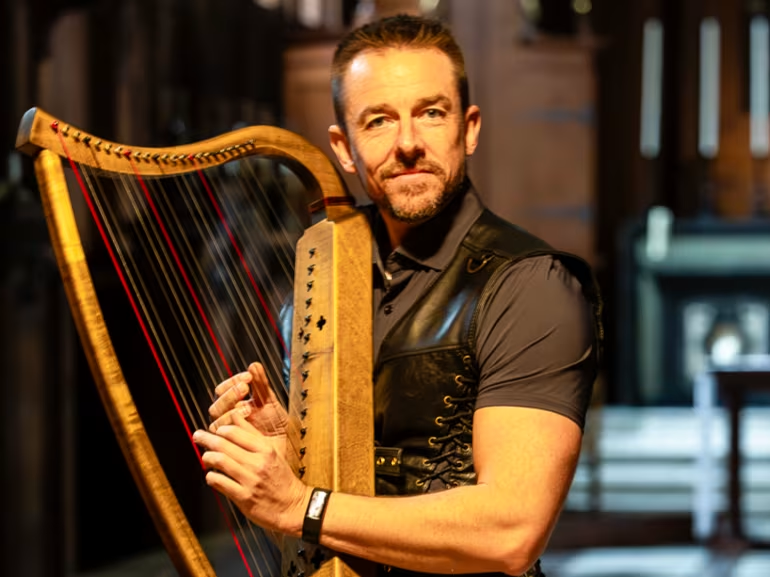
It actually comes from not too far down the road from you, Simon, in Scotland – a wonderful historical harp maker called Ardival Harps. I should say Leah Stuttard is harper first and foremost in the group, and she'd have wonderful things to tell you about her bray harp and her angel harp. My own is an Ardival, of a type that would have been around Europe in the 13th century, reconstructed from a depiction on a surviving altarpiece – an instrument called the cythara anglica, 'the English harp'. For accompanying singing, it works beautifully – you've got that same timbral relationship as voice and guitar, or voice and lute, the plucked timbre against the sustained timbre of the voice.
What sort of range has it got – a significant bass range, or is it mostly treble-based?
Mine goes down to the C below middle C, and up to about the G two and a half octaves above that – so mostly in the treble register. There's a lot of technology in harp construction in terms of how much pull that thin soundboard can take; gut strings are very strong, and part of the reason for the treble pitch range is around that limit. But there's also something about the handheld nature of it – you read some of the Medieval stories about the harp and how people regarded it, this semi-divine quality of the sound and of the harpists who played it. It's in a completely different cultural position to an orchestral harp. Being able to carry it with you and summon that sound was the core of the idea, as opposed to extending the bass register, which becomes more important in later periods.
The harp was the natural instrument of the wandering bard – it was also banned in Ireland by Elizabeth I as a hanging offence, because it was such a politically potent way of getting a message across. On the subject of what's coming up – you've got three programmes on the go at St Sepulchre. Are you performing anywhere else?
This year St Sepulchre is home base; next year we're likely to use a combination of venues. At the moment it's where to find us – which, for listeners outside London, is extremely close to City Thameslink station. In due course we'll absolutely look outside London – there are wonderful Medieval spaces to perform in, though one of the things that characterises London is a relatively limited number of them, and those that survive are, to my mind, incredibly precious. For example, St Bartholomew the Great, the retrochoir of Southwark Cathedral right near Green Dragon Court, and others. The Medieval London Music Festival, which I co-direct, is looking at that range of Medieval London spaces.
And the festival itself – when's that happening?
Spring 2027. Our group has a mailing list, which is a great way to stay in touch, and the Medieval Festival has one too – there was a good feature piece on it recently by my fellow co-Artistic Director, Daniel Thompson.
Coming back to the St Sepulchre programme – the theme is 'Bestiaries and Bishops', deliberately chosen because I think what modern audiences often see, on Instagram or elsewhere, are little snippets of manuscript illumination – beasts, or bishop figures – usually without any context. But there's so much richness as soon as you delve into these elements properly.
We do a huge amount of work to prepare for these concerts – my colleagues spend a lot of time in libraries, learning old languages – but I'll give you one example. Godric of Finchale, born just after the Battle of Hastings, around 1070, is credited with the oldest surviving songs in English. One of the 'bishop' pieces in the concert is his song about St Nicholas, the fourth-century bishop – the earliest surviving music in English. That's contrasted with later material, and one of the things I've loved about this programme is seeing how 'bestiaries' and 'bishops' turn out to be more integrated than you'd think, much like the Bishop of Winchester – the evangelists had their own animal avatars, the lion, the ox, and the eagle. Separately, there's a hilarious 15th-century German piece we're doing about village birds and creatures, which cheekily compares one bird's head movements to those of the local priest. Once you delve into the music through concepts like these, rather than simply working through the years without considering the relationship to the modern day, you find an amazing array of sounds and ideas that still resonate.
Medieval music is as much about gargoyles as saints, isn't it?! I look forward to hearing it – thank you very much.
Thank you so much for your time, Simon.
Green Dragon Guild of London will perform 'Of Bestiaries and Bishops' on 23 September at St Sepulchre-without-Newgate and a winter-themed programme 'Of Carols and Chimeras' on 20 November. Read more about the new Medieval London Music Festival here, with full details expected in the new year.
Share this
Keep reading
Mary-Jannet Leith on collaborating with the Buskaid Soweto String Ensemble
In the first of a new series of Continuo Connect podcasts, Simon Mundy talks to Mary-Jannet Leith of Ensemble Hesperi about their collaboration with the Buskaid Soweto String Ensemble, and the music that once filled Scotland's country houses.
Hugh Cutting: a countertenor in counterpoint
Countertenor Hugh Cutting talks to Continuo Connect about the physical joy of singing, Bach’s gifts to the countertenor and his determination to make music from the past speak to the present.
In conversation: Bolette Roed
Continuo Connect talks to the Danish recorder player Bolette Roed about her group, the Elephant House Quartet, and Copenhagen Baroque Festival.