

Recording
Time Stands Still | Kieran White & Cédric Meyer
John Dowland & John Danyel
Share this

BY ANDREW KING | FIRST PUBLISHED 4 APR 2026
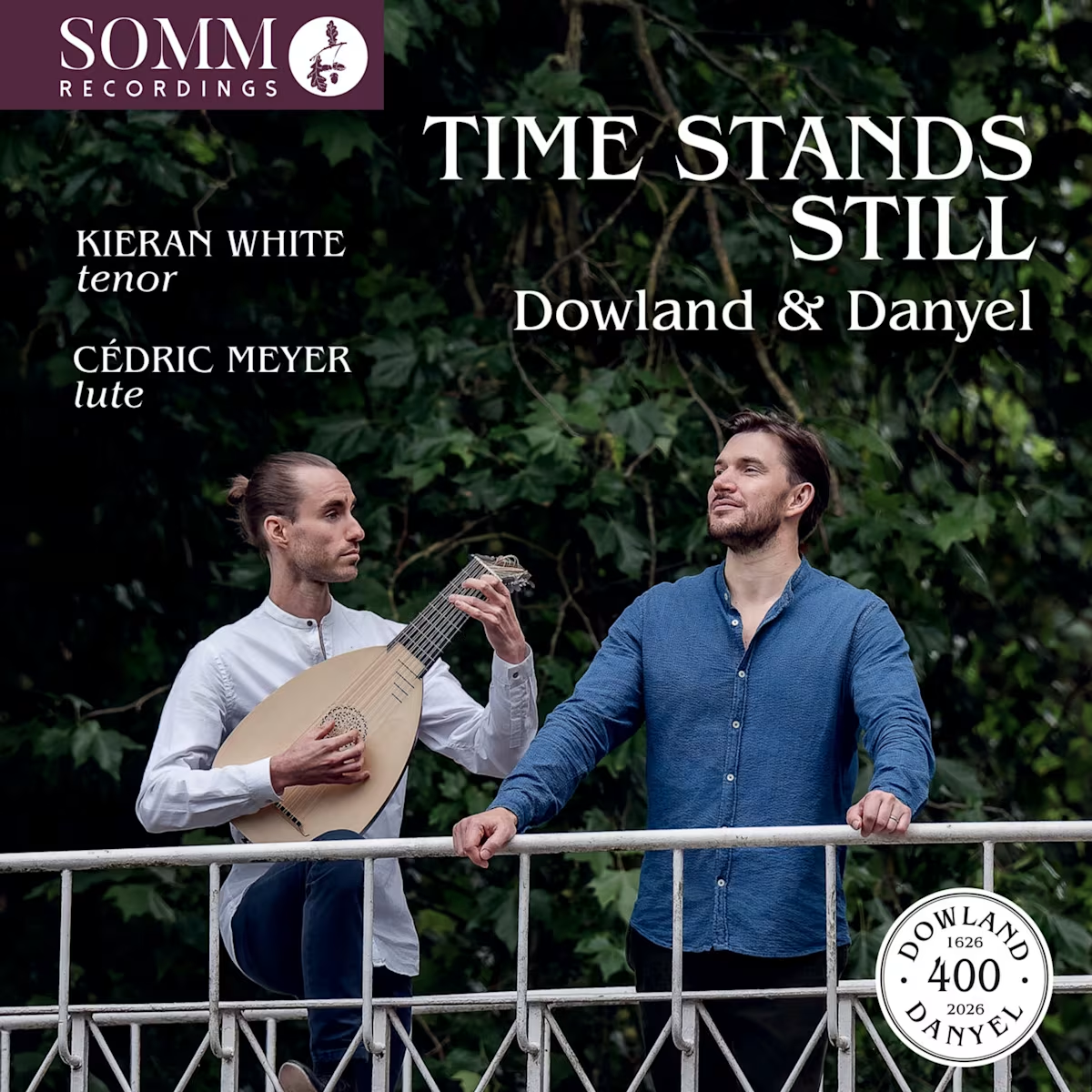
SOMM Recordings celebrates the 400th anniversary of two Renaissance masters of the First Golden Age of English Song: John Dowland (1563–1626) and John Danyel (1564–1626). This recital for tenor and lute takes its name from Dowland’s song, Time Stands Still.
The recording features British tenor Kieran White, who was a chorister at Wells Cathedral and held a Kohn Foundation Scholarship at the Royal Academy of Music. The Guardian has praised White’s ‘pure, luminous tenor’ and Opera Magazine his ‘extraordinary emotional clarity.’ He performs with long-time collaborator and friend, the Swiss-French lutenist Cédric Meyer, who holds two Masters of Arts and a postgraduate certificate with a specialisation in Early Music. Meyer plays here on his personally handcrafted eight-course Renaissance lute, based on an extant Italian lute from 1592, designed and hand-built to suit the timbre of Kieran White’s voice.
John Dowland’s ‘Time Stands Still’ from The Third Booke of Songs
Lute songs, or ‘ayres’, combine music and poetry to create songs that are filled with love, melancholy, and despair. John Dowland is acknowledged as the premier secular lute song composer of the late-16th and early-17th centuries, with a special affinity for the melancholy. It was a distinction he relished, even punning on his own name in the lute solo, Semper Dowland, semper dolens (‘Always Dowland, always doleful’).
Dowland’s status as a god of Early Music enthusiasts is matched by his astute business sense. To prevent unscrupulous printers from distributing his work in pirated editions, Dowland preserved his music by publishing it himself. The lute songs on this recording come from the First Booke of Songes or Ayres, published in 1597; the Second Booke, 1600; the Third and Last Booke, 1603; and A Musicall Banquet published by Dowland’s son Robert in 1610. The texts are predominantly by anonymous authors.
John Dowland’s ‘In Darkness let me dwell’ from A Musicall Banquet
Unlike his enterprising publication of lute songs, Dowland never printed a definitive collection of his solo lute music. The four lute solos recorded here come from varying sources, with the result that not all can be definitively attributed. Nevertheless, the solo instrumental pieces offer a taste of the highly refined art of lute playing at the turn of the 17th century.
Dowland’s superstar reputation is diametrically opposed to that of his exact contemporary, John Danyel, whose vocal music survives in a single, slender volume, First Booke of Songes or Ayres – 21 Songs for the lute, viol, and voice – published in 1606. Danyel seems to have come from a wealthy family. He graduated from Oxford, served as a tutor and court musician, and his privacy could well have been by choice. Yet these few pieces that have survived illustrate the uniquely sensitive mind of a skillful composer. Despite being less prolific and remaining comparatively obscure, noted Early Music specialists consider every one of Danyel’s extant works a masterpiece.
John Danyel ‘Have all our Passions’ from Mrs M.E. Her Funeral tears for the Death of her Husband
TRACKS
John Dowland
The Third Booke of Songs or Ayres
‘Time stands still’
Preludium, P98
The First Book of Songs or Ayres
‘Can she excuse my wrongs?’
‘Come again! Sweet love doth now invite’
‘Now, oh now I needs must part’
‘Come, heavy sleep’
Mr. Dowland’s Midnight, P99
The Second Book of Songs or Ayres
‘Flow, my tears’
A Fancy, P5
A Musicall Banquet
‘Far from triumphing court’
‘In darkness let me dwell’
A Fancy, P73
John Danyel
Songs for the Lute, Viol and Voice
‘Time, cruel time’
‘Stay, cruel, stay’
‘Why canst thou not’
Like as the lute’
‘Let not Cloris think’
Mrs. M.E. her funeral tears for the death of her husband
I. ‘Grief, keep within’
II. ‘Drop not, mine eyes’
III. ‘Have all our passions’
The album can be purchased from SOMM Records, and streamed on all major platforms.
Share this
Keep reading
In conversation: Samuel Ng
Continuo Connect catches up with Samuel Ng, cellist and gamba player with the newly formed Republic of Viols and Liturina.

JS Bach, and a cabinet of curiosities: Jorge Jiménez
Violinist, director and composer Jorge Jiménez talks to Simon Mundy about his latest album Curiosa: Lost & Found Tunes, his new Bach weekend in Ipswich, and his freelance career balancing life in rural Essex with regular work in Spain.

Celebrating 300 years of Academy of Ancient Music
Three hundred years after the first Academy of Ancient Music was founded, its modern namesake is preparing a season that looks far beyond commemoration.